The Complete Google Ads for Doctors SEO Outline: Patient Acquisition Blueprint
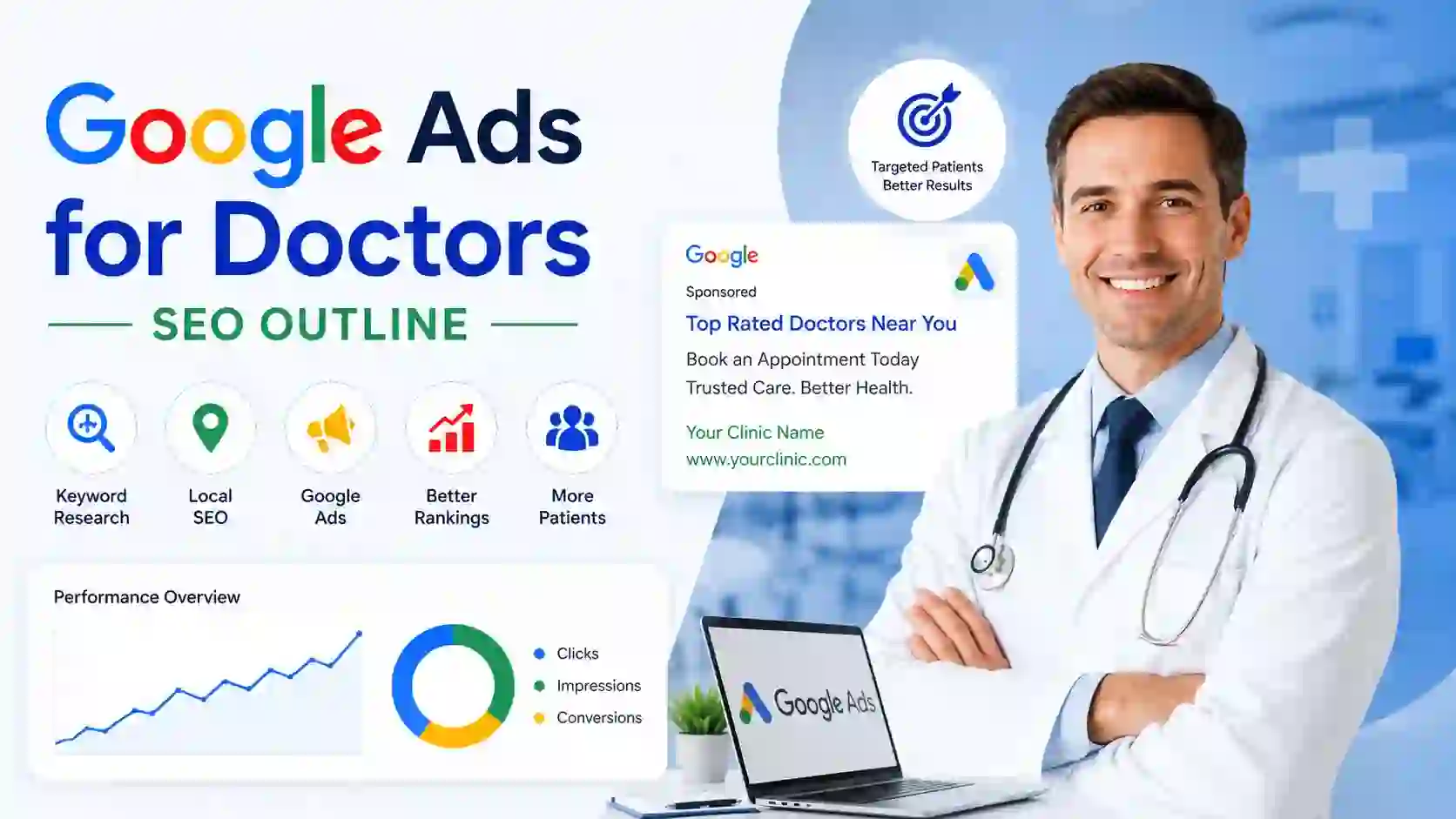
Many doctors rely solely on SEO and wait months for results. Meanwhile, competitors snatch patients through paid ads, leaving your practice invisible when patients search right now. This Google Ads for doctors SEO outline shows exactly how to combine both for immediate and sustainable patient growth.
Why Your Practice Needs Both Google Ads and SEO
A doctor’s website ranking on page one organically takes time. Google Ads puts you at the top of the search results today. When you blend the two, you capture high-intent patients at every stage — those ready to book and those still researching.
SEO builds trust and long-term authority. Paid search delivers instant visibility. Together, they create a feedback loop: ad data reveals which keywords convert, and you optimize your organic content for those terms. This integrated approach is the core of a solid Google Ads for doctors SEO outline.
A study by Think with Google found that search drives nearly three times as many visitors to hospital sites as non-search channels. Ignoring either channel leaves patient volume on the table.
The Patient Journey: How Search Intent Drives Results
Patients don’t stumble into your practice. They search with specific intent: “pediatrician near me open now,” “best knee surgeon reviews,” or “why does my shoulder hurt when lifting.” Each query signals a different stage.
Mapping intent lets you align ads and content:
- “Near me” and emergency queries → High intent. Serve immediate Google Ads with click-to-call.
- Symptom and condition searches → Educational blog posts (SEO) plus subtle retargeting ads.
- “Best doctor for X” or “reviews” → Reputation-driven SEO pages and Google Business Profile ads.
Your Google Ads for doctors SEO outline must start with this patient intent map, because a misaligned ad wastes budget and an unfocused SEO page never ranks.
Keyword Mapping: Aligning Paid and Organic Terms
A disjointed keyword strategy kills performance. Build a single keyword universe and divide it into three buckets:
| Bucket | Role | Example Keywords |
| Bottom-Funnel (Ads Priority) | Immediate bookings, high cost-per-click | “urgent care near me,” “cardiologist accepting new patients” |
| Mid-Funnel (Shared) | Conditions, treatments, comparisons | “minimally invasive hip replacement cost,” “what is sports cardiology” |
| Top-Funnel (SEO Priority) | Education, symptoms, lifestyle | “how to lower cholesterol naturally,” “signs of a heart attack in women” |
Use Google Keyword Planner, Search Console, and competitor analysis to fill each bucket. Then schedule quarterly audits. Changes in patient behavior show up in search term reports first.
This structured keyword mapping is a step inside every effective Google Ads for doctors SEO outline.
Creating Landing Pages That Convert and Rank
Sending ad traffic to your homepage burns money. Each ad group needs a dedicated landing page that answers the exact query. At the same time, build similar organic pages that target the same keyword but with richer educational content.
A high-converting doctor landing page includes:
- A single, clear headline matching the ad’s promise
- Real patient stories or video testimonials (with consent)
- Click-to-call button and a short appointment form
- Trust signals: board certifications, hospital affiliations, awards
- Fast load time (under 2 seconds)
For SEO, expand that page into a comprehensive guide with FAQs, but keep the booking pathway front and center. Google rewards pages that serve user intent completely.
Writing Ad Copy That Complies with Medical Advertising Rules
Medical ads face stricter policies. Google’s healthcare and medicines policy prohibits unverified claims, before-and-after images in certain categories, and promotion of prescription drugs without certification.
Apply these ad copy principles:
- Focus on outcomes that patients can expect, not guarantees. Use “Find relief from chronic knee pain” instead of “We cure knee pain.”
- Highlight credentials: “Board-certified orthopedic surgeon, 15+ years.”
- Include location extensions and call assets to drive foot traffic.
- Avoid superlatives that imply superiority — stick to facts.
Each ad must feel human, ethical, and compliant. The trust you build with honest ads feeds directly into your SEO reputation.
Setting a Google Ads Budget That Maximizes Patient Appointments
Doctors often overpay for clicks on broad, low-intent terms. A clean budget structure from your Google Ads for doctors SEO outline stops the bleed.
Monthly budget breakdown for a single-specialty practice:
- 70% on high-intent keywords (condition + location, “book appointment” modifiers)
- 20% on competitor brand terms (capture patients searching for other practices)
- 10% on remarketing (re-engage website visitors, with HIPAA safeguards)
Track cost per patient acquisition, not just cost per click. The return on investment is obvious if a procedure brings in $5,000 and you have to pay $200 to get that patient. Instead of using vanity metrics, base bid adjustments on appointment conversion values.
HIPAA-Compliant Conversion Tracking for Doctors
Tracking patient actions without violating HIPAA requires careful setup. Standard Google Ads conversion scripts can transmit protected health information (PHI) if placed on appointment forms or patient portals.
Safe tracking actions you can measure:
- Clicks to call from ads (use Google forwarding numbers)
- Direction requests to your clinic
- Form submissions on HIPAA-compliant landing pages with data redaction
- Live chat initiations, provided no PHI is stored in chat transcripts
Always sign a Business Associate Agreement (BAA) with any tool that touches patient data. Google Analytics is not HIPAA-compliant by default, so use server-side tracking and avoid sending any identifiers. Following these rules keeps your Google Ads for doctors SEO outline legally sound.
Using Google Business Profile to Amplify Ads and SEO
Your Google Business Profile sits at the intersection of local SEO and paid search. When you connect it to Google Ads, you show location assets that boost click-through rates by 10-15%.
Steps to maximize the synergy:
- Fill every section: services, Q&A, photos, appointment links.
- Post weekly updates with offers, new services, or health tips.
- Enable messaging and respond within minutes.
- Use Google Ads location extensions so your address, phone, and hours appear with ad copy.
For local searches, the 3-pack map listing feeds on profile completeness and reviews. An optimized profile lifts your organic local ranking and lowers your ad cost per click through higher Quality Scores.
Retargeting Without Violating Patient Privacy
Patient retargeting sounds appealing but runs straight into HIPAA walls. You cannot build audience lists based on sensitive health conditions or site visits to condition-specific pages.
Compliant remarketing strategies:
- Target visitors of non-condition pages: your homepage, “About Us,” insurance information, and blog posts on general wellness.
- Exclude pages that reveal health conditions from your audience lists.
- Use time-based exclusions to avoid over-serving ads to the same user.
- Create content-based remarketing: show ads for a free guide on “Questions to Ask Your Surgeon” to users who read related blog content, without implying their medical status.
A privacy-first retargeting plan keeps your Google Ads for doctors SEO outline safe from fines and reputational damage.
Measuring What Matters: Patient Acquisition Cost and Lifetime Value
Vanity metrics hide the real picture. For a practice, the only numbers that matter are new patient appointments, cost per acquisition, and patient lifetime value.
Set up a dashboard that tracks:
- New patient calls and form fills from ads vs. organic
- Revenue per new patient (by procedure or service line)
- ROI by campaign, ad group, and keyword
- Patient retention rate and referral rate over 12 months
When you connect these to your Google Ads for doctors SEO outline, you stop guessing and start scaling. Shift budget daily toward the campaigns that fill your exam rooms.
Common Google Ads Mistakes Doctors Make (and How to Fix Them)
- Bidding on broad match without negative keywords
Fix: Add negative terms like “free,” “jobs,” “salary,” “pictures,” “definition.” Block unrelated queries immediately. - Ignoring mobile optimization
Fix: 60% of health searches happen on mobile. Use responsive search ads, mobile-first landing pages, and click-to-call buttons. - Setting and forgetting campaigns
Fix: Review search terms weekly. Pause underperformers and add new negative keywords. A stale campaign bleeds budget. - Using a single landing page for all ads
Fix: Match each ad group to a unique landing page. Message match improves Quality Score and conversions. - Not linking Google Business Profile and Ads
Fix: Enable location extensions and local campaigns to capture “near me” searches.
A Step-by-Step Google Ads for Doctors SEO Outline
Here is your action-ready framework:
- Audit existing SEO — Find pages ranking positions 4-15. These are your quick wins.
- Run a 2-week Google Ads test on 20 high-intent keywords. Collect conversion and click data.
- Identify top-converting search terms from the ads Search Terms report.
- Create or update SEO content around those exact terms. Include schema markup for physicians.
- Build dedicated landing pages for ad groups. Keep them fast and HIPAA-safe.
- Set up compliant conversion tracking and link Google Business Profile.
- Launch remarketing using non-sensitive site sections.
- Review weekly — shift budget from low-converting keywords to winners. Update SEO pages with fresh data and patient questions.
Repeat this cycle quarterly. Each iteration tightens the connection between paid and organic search, cementing your authority and patient flow.
Frequently Asked Questions
1. Can I use Google Ads if my practice is new and my website has no SEO authority?
Yes. Google Ads does not depend on domain authority. You can start running ads immediately while building your SEO foundation in parallel.
2. How long until I see patients from the combined Google Ads and SEO approach?
Ads bring inquiries within 24-48 hours. SEO typically shows measurable growth in 3-6 months. Together, you get immediate appointments plus compounding long-term traffic.
3. Is it safe to track phone calls from Google Ads for a medical practice?
Yes, if you use a Google forwarding number that does not record calls without consent. Always consult your compliance officer and ensure any call recording system is HIPAA-compliant.
4. What’s the minimum monthly budget I should set for a specialist doctor’s campaign?
A realistic starting point is $1,500–$3,000 per month for a single-specialty practice in a mid-sized city. This enables adequate data for efficient optimization.
5. Do I need different strategies for different specialties?
Absolutely. A dermatologist’s ad copy, keywords, and landing pages differ completely from a cardiologist’s. Tailor every element of your Google Ads for doctors SEO outline to the specific specialty and patient journey.
6. How do I protect patient privacy while using analytics to improve campaigns?
Use server-side tracking, avoid sending PHI to analytics platforms, sign BAAs with all vendors, and strictly exclude condition-specific URLs from remarketing lists. Work with a developer experienced in healthcare tracking.
Your Next Move: Turn This Outline into Patients
You now hold a complete Google Ads for doctors SEO outline that merges immediate paid visibility with lasting organic growth. Stop relying on a single channel. Start a 14-day ad pilot using the keyword mapping above, build the matching landing pages, and feed those insights into your SEO content engine. Each week you delay, a competitor captures the patients searching for your services right now.
Ready to implement this in your practice? Download the companion “Google Ads for Doctors Campaign Setup Checklist” and schedule a strategy call with our healthcare marketing team. Let’s fill your appointment slots.
Sources
- Google Ads Healthcare and Medicines Policy
- HHS HIPAA Guidelines on Online Tracking Technologies
- Think with Google, “The Digital Journey to Health and Wellness” (2023)
- JMIR Publications, “Search Engine Use for Health Information” (2022)