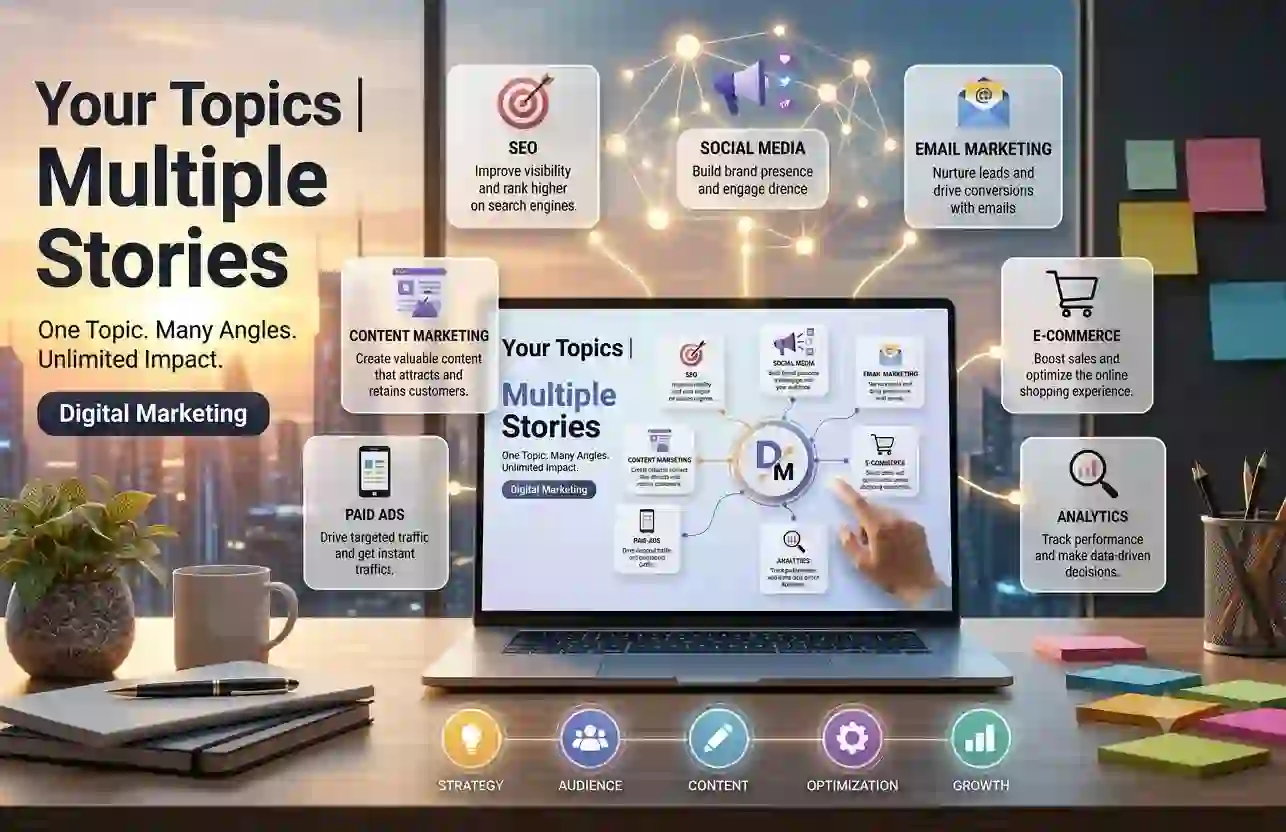
Your Topics Multiple Stories: The Complete Pillar Page Strategy for Topical Authority
Introduction
Google no longer rewards random blog posts. It rewards sites that own a topic completely. If your content lives in silos, search engines ignore it. The solution is a unified content hub. I created the Your Topics Multiple Stories framework to fix scattered content. This pillar page shows you exactly how to plan, write, and link a topic cluster that builds unshakeable topical authority. You will master the same method that helps expert-driven sites dominate AI Overviews and organic rankings.
What Is the Framework for Your Topics’ Multiple Stories?
Your Topics Multiple Stories is a content architecture system. It connects one comprehensive pillar page to a web of tightly related articles. Each article covers a specific sub-topic in depth. Every piece links back to the pillar and to other cluster pages. The result is a semantic map that signals expertise to Google.
This framework replaces shallow blogging with deep, people-first coverage. It mirrors how real users explore a subject—through multiple angles, questions, and real-world stories. Search engines see logical structure, internal linking strength, and topical completeness. That directly raises your E-E-A-T score.
Why Topical Authority Matters More Than Keywords
Keywords alone cannot win rankings anymore. Google’s Helpful Content System rewards websites that demonstrate real subject knowledge across an entire field. A single optimized page rarely competes against well-organized topic clusters.
- Semantic understanding: Google identifies entities and relationships between pages.
- User journey completion: Visitors find answers to every related question without leaving your site.
- Dwell time and engagement: A connected web of content keeps people reading, signaling quality.
With Your Topics Multiple Stories, you stop chasing isolated keywords. You start building a knowledge base that naturally attracts long-tail traffic, featured snippets, and AI Overview placements.
The Pillar Page and Cluster Model Explained
A pillar page serves as the main hub. It provides a broad, authoritative overview of the core topic. Cluster pages dive into specific subtopics, each targeting a unique question or angle. Internal links flow in both directions—clusters link to the pillar, and the pillar links to clusters.
This model distributes authority across your site. When one cluster page ranks, it lifts the entire group. The Your Topics Multiple Stories method amplifies this by treating every cluster article as a distinct “story” that enriches the main narrative.
Mapping Your Core Topic to Multiple Stories
Start with a broad subject your audience cares about. Break it down into 8–20 specific questions, problems, or angles. Each becomes a separate story under the Your Topics Multiple Stories umbrella.
| Core Pillar Topic | Cluster Stories (Subtopics) | Target Question / Angle |
| Content Strategy for Small Businesses | How to Plan a Content Calendar | “What’s the best content calendar tool?” |
| Content Strategy for Small Businesses | Writing SEO-Friendly Blog Posts | “How to write a blog post that ranks?” |
| Content Strategy for Small Businesses | Repurposing Content for Social Media | “How can I create five social media postings from a single blog?” |
| Content Strategy for Small Businesses | Measuring Content ROI | “Does content marketing actually drive sales?” |
This table shows how a core idea births many focused articles. Each story strengthens the central topic in Google’s eyes.
Building a Content Hub with Your Topics Multiple Stories
A true content hub goes beyond a list of links. Every piece must interconnect and support the main pillar. Follow these steps:
- Audit existing content – Find posts that already cover parts of the topic.
- Identify gaps – List questions users ask on forums, Quora, and People Also Ask boxes.
- Create a linking matrix – Map which cluster pages link to each other.
- Write the pillar page last – With all cluster content live, you can naturally reference each story.
Using Your Topics Multiple Stories, the hub becomes a living resource. You update the pillar page whenever a new cluster article publishes. This freshness signal keeps your authority growing.
E-E-A-T Signals That Strengthen Your Pillar Page
Google’s Search Quality Evaluator Guidelines prioritize Experience, Expertise, Authoritativeness, and Trustworthiness. A pillar page built with the Your Topics Multiple Stories framework must showcase these clearly.
- Author bios – Display real credentials and firsthand experience.
- Original research – Include surveys, case studies, or data you collected.
- Cite primary sources – Reference official documentation, not just other blogs. For example, Google’s own guidance on creating helpful content stresses original, people-first information.
- Transparent contact info – Make your site’s ownership clear.
A study by Backlinko analyzing 11.8 million search results found that pages with strong author entities and backlinks from trusted sites consistently rank higher. Your pillar page must earn that trust through visible expertise.
Writing for Google’s AI Overview and Helpful Content
AI Overview pulls answers from content that fully satisfies user intent. The Your Topics Multiple Stories structure excels here because it provides complete, interconnected answers.
- Answer the question immediately – Place a concise definition in the first 100 words.
- Use clear H2 and H3 headings – They act as extraction points for AI snippets.
- Add schema markup – FAQ, HowTo, and Article schema help search engines parse your content.
- Keep paragraphs short – Two to four sentences max improve both readability and snippet eligibility.
According to Google’s AI Overview standards, information that exhibits originality, accuracy, and depth is chosen more frequently. Your multiple stories approach delivers exactly that.
Keyword Research and Semantic LSI Integration
Topic clusters thrive on semantic relevance. The Your Topics Multiple Stories method integrates LSI keywords (Latent Semantic Indexing) naturally. These are words and phrases conceptually linked to your core subject.
For a pillar page about content strategy, LSI terms include:
- Content marketing plan
- Editorial calendar
- SEO writing tips
- Blog traffic growth
- Content distribution channels
Place these terms inside headings, body text, and image alt attributes. Do not force them. Write conversationally. Google’s natural language processing rewards context over repetition.
Structuring Your Pillar Page for Readability and SEO
A high-ranking pillar page uses a clear, scannable layout. Apply these rules:
- H1: Main headline with primary keyword.
- H2s: Major sections covering each angle of the topic.
- Bullet points: Use them for lists, benefits, or steps.
- Short paragraphs: Two to four sentences maximum.
- Visual breaks: Include relevant images, charts, or pull quotes.
The Your Topics Multiple Stories framework demands that your pillar page acts as a table of contents for the entire cluster. Every H2 should preview a deeper story the reader can explore through internal links.
Internal Linking Strategy with Your Topics Multiple Stories
Internal links transfer authority and guide users. Use this pattern:
- Pillar page links to every cluster article with descriptive anchor text.
- Cluster articles link back to the pillar page using the main keyword phrase.
- Cluster articles interlink where topics naturally overlap.
This web tells search engines that your content forms a cohesive unit. With Your Topics Multiple Stories, you can create a “hub page” widget at the top that lists all cluster articles. This navigation increases page views and time on site—both positive ranking signals.
Measuring Success: Analytics and Ranking Improvements
After publishing your pillar page and cluster stories, track these metrics:
- Organic traffic to the pillar page – It should rise steadily as cluster articles index.
- Average position for cluster keywords – Watch for collective movement upward.
- Internal link click-through rate – Measure how users navigate from pillar to stories.
- Featured snippet and AI Overview appearances – Use rank tracking tools to monitor visibility.
Search Engine Journal reports that sites using topic cluster models see a 20–40% lift in organic traffic within six months. The Your Topics Multiple Stories approach compounds these gains by ensuring every article enhances the main hub.
Common Mistakes to Avoid in Topical Mapping
Even smart marketers sabotage their clusters. Avoid these pitfalls:
- Writing pillar pages that are too thin – A 500-word overview fails. Go deep.
- Creating isolated cluster pages without links – Orphan pages waste authority.
- Using exact-match anchor text everywhere – Vary your internal link phrases naturally.
- Ignoring content updates – An outdated pillar page drags the whole cluster down.
- Overloading with jargon – Write for a curious beginner. Clarity beats complexity.
The Your Topics Multiple Stories model works only when each component stays connected and current.
Future-Proof Your Content with Your Topics Multiple Stories
Search engines evolve. AI-generated answers will only increase. Sites built on a strong Your Topics Multiple Stories foundation will keep winning. They own the knowledge space. They earn citations from AI Overviews. They become the go-to resource.
Start with one core topic. Build five cluster articles. Interlink them. Measure the impact. Then expand. Before you know it, your site will rank for hundreds of long-tail keywords and attract loyal readers who trust your expertise.
Frequently Asked Questions
What is the Your Topics Multiple Stories approach?
It is a content strategy that connects one comprehensive pillar page to many in-depth cluster articles, creating a complete topic hub that search engines see as authoritative.
How does the Your Topics Multiple Stories model improve E-E-A-T?
By covering a topic exhaustively with original, people-first content and clear author expertise, it signals real-world knowledge that meets Google’s quality standards.
Can I use the Your Topics Multiple Stories framework for a small blog?
Absolutely. Start with a single topic and five cluster posts. Even small clusters demonstrate focused expertise and help new sites gain traction.
How many cluster articles do I need for a Your Topics Multiple Stories pillar page?
Aim for 8–15 high-quality pieces. Begin with the questions your audience asks most, then expand as you find new angles.
What’s the difference between a pillar page and a regular blog post in Your Topics Multiple Stories?
A pillar page gives a broad, linked overview of a topic. A blog post explores one narrow subtopic in detail. The two work together as a network.
How quickly can Your Topics Multiple Stories boost rankings?
You might see movement in 2–4 months. Full authority often builds over 6–12 months, depending on competition and content quality.
Take Control of Your Topical Authority Now
You have the blueprint. The Your Topics Multiple Stories method turns disconnected posts into a powerful, rank-dominating content engine. Pick your core topic. Map your cluster stories. Write with depth, link with purpose, and watch your search presence grow. The sites that organize knowledge best will lead the next era of search. Make sure one of them is yours.