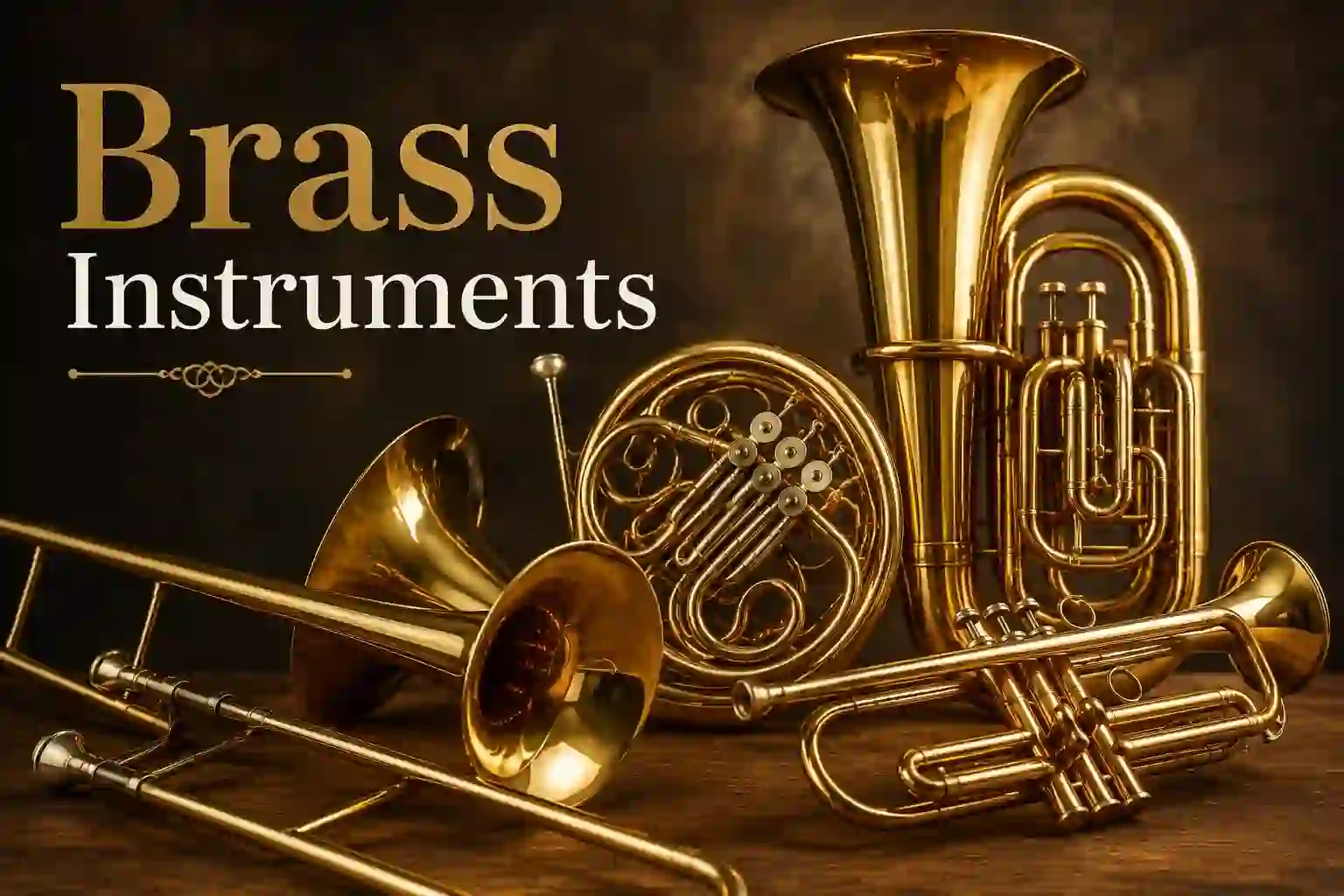
What Are Brass Instruments? Everything You Need to Know in 2026
Introduction
Your lips touch a small metal cup, you buzz — and a full, golden sound fills the room. That’s the power of brass instruments. Yet most people don’t know why they sound so different from every other instrument, how to pick the right one, or what makes the tuba sound nothing like the trumpet. This guide answers all of it. You will leave with a clear, honest image of the complete brass family, whatever of your level of experience.
What Are Brass Instruments?
Brass instruments are a family of wind instruments that produce sound when a player buzzes their lips into a cup-shaped or funnel-shaped mouthpiece. The vibration of the lips sets the air column inside the tubing in motion, and that vibration creates the characteristic warm, resonant tone the brass family is known for.
Despite the name, not every brass instrument is made of brass. The French horn, for example, has historically been made from different metal alloys, and some modern instruments use nickel silver or even plastic. What defines the family is the method of sound production — the lip buzz — not the material.
Brass instruments belong to the broader category of aerophone instruments, meaning sound comes from vibrating air. The International Musicological Society classifies them under the Hornbostel-Sachs system as “lip-vibrated aerophones.” (Source: Hornbostel & Sachs, 1914, revised classification)
A Brief History of Brass Instruments
Brass instruments trace their roots back thousands of years. Ancient cultures used animal horns and hollowed tusks to signal across distances. By 1500 BCE, Egyptian trumpets appeared — two of which were found in Tutankhamun’s tomb and are among the oldest brass instruments ever discovered.
The natural horn and natural trumpet dominated European music through the Renaissance and Baroque periods. These instruments had no valves; players changed pitch entirely through lip tension and breath control, which required extraordinary skill.
The valve system changed everything. Heinrich Stölzel and Friedrich Blühmel patented the first rotary valve in 1818 in Prussia, and that single invention made modern orchestral brass playing possible. The tuba followed in 1835, designed by Wilhelm Wieprecht and Johann Gottfried Moritz to fill the bass register in military bands.
By the late 19th century, Adolphe Sax (the same inventor behind the saxophone) refined the design of several brass instruments, pushing the industry toward the standardized forms we recognize today.
How Do Brass Instruments Work? (The Science Behind the Sound)
Understanding how brass instruments produce sound makes you a smarter player and a sharper listener.
Step 1 — The Lip Buzz The player presses their lips against the mouthpiece and buzzes them together at a controlled speed. This is called embouchure (pronounced “AHM-buh-shoor”). The pitch rises with increasing buzz speed and tightness.
Step 2 — Air Column Vibration The buzz sets the column of air inside the tubing vibrating. The length and shape of that tubing determines which notes resonate naturally. These natural resonant pitches are called the overtone series or harmonic series.
Step 3 — Changing Pitch Players change pitch in two main ways:
- Valves — pressing a valve opens extra tubing, making the air column longer and lowering the pitch (trumpet, tuba, French horn)
- Slides — extending a slide physically lengthens the tube (trombone)
- Embouchure adjustment — subtle changes in lip tension shift between harmonics on any brass instrument
Step 4 — The Bell The bell at the end of the instrument amplifies the sound and shapes its tone color. A wider, more flared bell produces a warmer, broader tone. A narrower bell gives a brighter, more focused sound.
The bore (the internal diameter of the tubing) also matters enormously. A cylindrical bore — consistent width throughout — produces a bright, direct tone (trumpet, trombone). A conical bore — gradually widening — gives a rounder, mellower tone (French horn, euphonium, tuba).
Complete List of Brass Instruments: Types and Characteristics
| Instrument | Bore Type | Key | Range | Common Role |
| Trumpet | Cylindrical | B♭ | E3–D6 | Lead melody, orchestra, jazz |
| Cornet | Conical | B♭ | E3–C6 | Brass bands, solos |
| Flugelhorn | Conical | B♭ | E3–B♭5 | Jazz, mellow solos |
| French Horn | Conical | F/B♭ | B1–F5 | Orchestra, chamber music |
| Trombone | Cylindrical | B♭ | E2–B♭5 | Orchestra, jazz, bands |
| Bass Trombone | Cylindrical | B♭ | B♭0–G5 | Low register, orchestra |
| Euphonium | Conical | B♭ | E2–B♭5 | Brass bands, solos |
| Baritone Horn | Conical | B♭ | E2–B♭5 | Concert bands |
| Tuba | Conical | B♭/C/F/E♭ | D1–F4 | Bass foundation |
| Sousaphone | Conical | B♭ | D1–F4 | Marching bands |
| Bugle | Cylindrical | B♭ | G3–C5 | Military, signaling |
| Piccolo Trumpet | Cylindrical | B♭/A | A3–A6 | Baroque repertoire |
| Cimbasso | Cylindrical | B♭/C | B♭0–G4 | Opera orchestras |
| Wagner Tuba | Conical | B♭/F | B1–F5 | Wagner operas |
| Alto Horn | Conical | E♭ | D3–E♭5 | Brass bands |
The Most Popular Brass Instruments Explained
1. The Trumpet
The trumpet sits at the top of the brass family in range and visibility. It uses three piston valves and cylindrical bore tubing to produce one of music’s most piercing, brilliant tones. The B♭ trumpet is the standard instrument, though C trumpets are preferred in orchestral settings.
Miles Davis, Louis Armstrong, and Wynton Marsalis built entire careers — and genres — on the trumpet’s voice. It plays lead roles in jazz, classical orchestras, military bands, and commercial music alike.
Best for: Students looking for a versatile, well-supported instrument with a wide range of repertoire and teaching resources.
2. The Trombone
The trombone is the only brass instrument in mainstream use that relies entirely on a slide rather than valves to change pitch. The player extends or retracts the slide to seven distinct positions, each adding a fixed length of tubing.
This design means the trombone can produce a perfectly smooth glissando — a continuous slide between pitches — that no other brass instrument can replicate. It’s essential in jazz, orchestral music, and marching bands.
Best for: Players who want to develop strong ear training and intonation skills, since the slide demands precise placement.
3. The French Horn
The French horn wraps its tubing into a circular coil, ending in a wide, flared bell. Players typically insert their right hand into the bell, which affects both tone and intonation — a technique called hand stopping.
Modern French horns are double horns, combining F and B♭ tubing in a single instrument with a thumb trigger to switch between them. This gives players greater flexibility across the instrument’s wide, three-plus-octave range.
The French horn’s mellow, complex tone sits at the heart of the orchestral brass section, and composers from Mozart to Mahler wrote some of the most demanding brass solos in the repertoire for it.
Best for: Committed students willing to invest in a technically demanding but tonally rewarding instrument.
4. The Tuba
The tuba is the largest and lowest brass instrument in standard use. Its conical bore and massive bell push sound into the lowest registers of the brass family, providing the harmonic foundation under the entire ensemble.
Tubas come in several sizes and pitches: B♭, C, E♭, and F, each suited to different contexts. The CC tuba is the orchestral standard in the United States. The sousaphone is a circular variant designed for marching bands, wrapping around the player’s body for easier carrying.
Best for: Larger students or those interested in providing the harmonic anchor in concert bands and orchestras.
5. The Euphonium
The euphonium is sometimes called the “cello of the brass family” because of its rich, warm, midrange voice. It uses conical bore tubing and four valves (some models use three) to cover a range similar to the trombone.
The euphonium is especially prominent in British brass band tradition, where it takes on soloistic roles that a tuba or trombone might handle in an American concert band. Steven Mead is widely recognized as the instrument’s leading contemporary voice.
Best for: Tuba players who want a lighter instrument, or trombone players moving to a valved instrument.
6. The Cornet
The cornet looks like a compact trumpet but uses conical bore tubing, which gives it a noticeably warmer, rounder tone. It was the dominant solo instrument in popular music of the late 19th and early 20th centuries before the trumpet took over in jazz.
British brass bands still use the cornet as their primary lead instrument, and the cornet solo repertoire — especially Victorian-era pieces by Herbert L. Clarke and Arthur Pryor — remains a staple of brass band competitions.
Best for: Very young beginners, since the cornet’s shorter tubing makes it slightly easier to hold and reach.
7. The Flugelhorn
The flugelhorn takes the same fingering system as the B♭ trumpet but uses a much wider, more conical bore. The result is one of the warmest, most enveloping sounds in all of brass playing — sometimes described as “velvety.”
Chet Baker and Art Farmer popularized the flugelhorn in jazz. It appears most often in jazz ballads, brass ensembles, and some military bands. Few instruments blend as naturally with strings or muted brass.
Best for: Trumpet players looking to add a contrasting, softer color to their playing.
Brass Instruments in Different Musical Settings
Symphony Orchestra The standard orchestral brass section includes 2–4 trumpets, 2–4 trombones, 4–8 French horns, and 1 tuba. In works by Richard Wagner, Gustav Mahler, and Richard Strauss, the brass section can expand to twenty players or more.
Concert Band / Wind Ensemble Concert bands replace string sections with additional winds and percussion. The brass section is larger proportionally, and instruments like the euphonium and baritone horn take on greater prominence.
Jazz Ensemble Jazz brass sections typically feature trumpets and trombones in a big band context, where they trade punching, syncopated ensemble figures with the saxophone section. Flugelhorns and cornets appear in smaller combo settings.
Marching Band Marching bands use sousaphones instead of tubas, mellophone (a marching version of the French horn), and bugles designed for outdoor projection. Soprano bugles, which are essentially marching trumpets tuned to G, are used by contemporary marching bands in drum corps competitions.
Brass Quintet The brass quintet — two trumpets, French horn, trombone, and tuba — is the most common chamber ensemble for brass instruments. Groups like the Canadian Brass and the Empire Brass Quintet have built international careers on this format.
How to Choose the Right Brass Instrument for You
Picking your first brass instrument is a decision that shapes years of practice, so think through these factors carefully.
Physical Fit
- Small hands and a young player → cornet or trumpet
- Strong air support and patience → French horn
- Comfort with size and weight → tuba or euphonium
- Physical coordination preference → trombone (slide requires spatial awareness)
Musical Goals
- Jazz → trumpet, trombone, or flugelhorn
- Orchestra → French horn, trumpet, or trombone
- Marching band → trumpet/mellophone, trombone, or sousaphone
- Brass band (British tradition) → cornet, euphonium, or baritone horn
Budget Guide (2025)
| Level | Trumpet | Trombone | French Horn | Tuba |
| Student | $300–$700 | $400–$800 | $1,200–$2,500 | $1,500–$3,500 |
| Intermediate | $700–$2,000 | $800–$2,500 | $2,500–$4,500 | $3,500–$7,000 |
| Professional | $2,000–$6,000+ | $2,500–$8,000+ | $4,500–$12,000+ | $7,000–$20,000+ |
Renting before buying is a practical first step, especially for students under 12 years old who may switch instruments as their interest develops.
Recommended Student Brands (2025): Yamaha, Bach (Vincent Bach), Jupiter, Conn-Selmer, and King are consistently rated by music educators for build quality and playability at the student level.
Brass Instrument Care and Maintenance
A well-maintained brass instrument plays better, lasts longer, and holds its resale value. These habits protect your investment.
Daily Habits
- Every time you play, empty the water keys (spit valves) since the accumulated moisture corrodes the tubing’s interior.
- Use valve oil on piston valves before every practice session
- Wipe the exterior with a soft cloth to remove fingerprints and oils from your hands
Weekly Habits
- Run a flexible cleaning snake through the leadpipe (the mouthpiece receiver tubing) to remove debris
- Apply slide grease to tuning slides to keep them moving freely
- Oil rotor valves (French horn, some tubas) with a lighter rotor oil, distinct from piston oil
Monthly Deep Clean
- Give the instrument a warm (never hot) bath in water with mild dish soap
- Use a brass instrument cleaning kit — flexible brushes in multiple sizes — to scrub the inside of tubing
- Rinse thoroughly and let dry completely before playing
Annual Professional Service
- Have a repair technician check valve alignment, dent repair, and lacquer condition once per year
- Mouthpieces should be cleaned weekly and inspected for rim damage that could harm embouchure development
Common Mistake to Avoid: Never use petroleum-based lubricants like WD-40 on valves. They break down the seals and destroy the valve action over time.
Developing Your Embouchure: The Foundation of Brass Playing
Embouchure is the single most important physical skill in brass playing. It determines your tone, your range, your endurance, and your ability to play consistently under pressure.
What Makes a Good Embouchure?
A healthy embouchure involves:
- Lips centered on the mouthpiece (generally 50/50 upper and lower lip, though individual anatomy varies)
- Corners of the mouth firm but not locked
- Chin flat, not bunched
- Air flowing freely without pinching the throat
Building Embouchure Strength
Teachers at institutions like the Juilliard School and the Royal Academy of Music consistently recommend these fundamentals:
- Long tone exercises: hold single pitches for four to eight beats at a comfortable dynamic and focus on pure tone quality
- Lip slurs: move between harmonics without using valves or the slide, training lip flexibility
- Mouthpiece buzzing: practice buzzing on the mouthpiece alone to isolate and strengthen the lip action
Embouchure development takes months. Rushing it by playing too loud or too long too early leads to injury. Most experienced brass teachers cap beginner practice sessions at 20–30 minutes per day in the first few months.
Famous Brass Players Who Shaped Music History
These musicians didn’t just play brass instruments — they changed what the instruments were capable of.
Louis Armstrong (Trumpet) — Redefined jazz improvisation in the 1920s and 30s. His ability to play above the normal trumpet range and his expressive tone set a standard that still influences players today.
Miles Davis (Trumpet) — Pioneered multiple jazz genres, from bebop to cool jazz to fusion. His use of the muted trumpet on Kind of Blue (Columbia Records, 1959) remains one of the most influential sounds in recorded music.
Dennis Brain (French Horn) — Considered the greatest French horn player of the 20th century. Benjamin Britten and Paul Hindemith wrote works specifically for him.
Christian Lindberg (Trombone) — A Swedish trombonist who essentially created the modern trombone solo repertoire by commissioning over 300 new works from composers worldwide.
Roger Bobo (Tuba) — Principal tuba of the Los Angeles Philharmonic for three decades and the player most responsible for establishing the tuba as a serious solo instrument.
Wynton Marsalis (Trumpet) — The first musician to win Grammy Awards in both jazz and classical categories in the same year (1983). He has led the Jazz at Lincoln Center Orchestra since its founding.
Brass Instruments vs. Woodwind Instruments: Key Differences
Players and educators often group brass and woodwind instruments together as the “wind family,” but the two groups work very differently.
| Feature | Brass Instruments | Woodwind Instruments |
| Sound Production | Lip buzz into mouthpiece | Air over reed or embouchure hole |
| Examples | Trumpet, tuba, French horn | Flute, clarinet, saxophone, oboe |
| Material | Metal (usually brass) | Wood, metal, plastic |
| Pitch Control | Valves/slide + embouchure | Keys and tone holes |
| Tone Character | Warm, projecting, powerful | Breathy to bright, varied |
| Beginner Difficulty | Moderate to hard | Moderate |
One important note: the saxophone is a woodwind instrument, not a brass instrument, even though it’s made of metal. It uses a single reed to produce sound, which places it firmly in the woodwind family by the standard Hornbostel-Sachs classification.
Brass Instruments in Modern Music and Pop Culture
Brass instruments have moved well beyond the concert hall and marching field. They appear in genres and contexts that would have seemed unlikely even fifty years ago.
Ska and Reggae: Jamaican ska music of the 1960s built its entire rhythmic identity around a brass section of trumpets and trombones. Bands like the Skatalites made the brass section the lead voice in popular music.
Hip-Hop Sampling: Producers from J Dilla to Kendrick Lamar’s DAMN. sessions have sampled jazz and soul brass recordings extensively, bringing the trumpet and trombone sound into 21st-century production.
Drum Corps International (DCI): Competitive marching organizations like the Blue Devils and the Cavaliers push brass playing to its technical limit, performing at over 100 decibels with absolute rhythmic precision.
Film Scoring: Composers like John Williams, Hans Zimmer, and Ennio Morricone built their most iconic cues around brass. The Star Wars main theme, The Dark Knight‘s Joker theme, and Morricone’s spaghetti western scores are inseparable from their brass orchestration.
New Orleans Second Line: The brass band tradition in New Orleans remains one of the most vibrant living examples of street brass music, with bands like the Dirty Dozen Brass Band and the Rebirth Brass Band carrying the tradition into contemporary performance.
Frequently Asked Questions About Brass Instruments
Q1: What is the easiest brass instrument for beginners?
The trumpet and the trombone are the most recommended starting points for beginners. The trumpet requires a smaller air stream, making it less physically demanding in the early stages. The trombone uses a slide, which some find more intuitive for understanding pitch because you physically move between positions. Both instruments have extensive teaching resources, affordable student models, and wide availability of teachers. The cornet is also excellent for very young students because its shorter tubing is easier to hold.
Q2: How long does it take to learn a brass instrument?
Most beginners produce a recognizable, steady tone within two to four weeks. Playing simple songs takes one to three months. Playing confidently in a school band or ensemble typically happens within six to twelve months of consistent practice. Reaching an intermediate level — comfortable with scales, basic technique, and ensemble playing — takes two to four years. Professional-level performance requires eight or more years of focused study. Daily practice, even for 20–30 minutes, produces faster results than occasional long sessions.
Q3: Are brass instruments loud? Can I practice at home?
Brass instruments are among the loudest acoustic instruments available. A trumpet at full volume measures approximately 85–110 decibels — comparable to a motorcycle engine. That said, practice mutes reduce volume significantly. Silent brass systems (most notably the Yamaha Silent Brass system) allow players to practice through headphones at whisper-quiet volumes. Practice mutes cost $30–$150 depending on quality. Apartment and noise-sensitive practice is realistic with the right mute.
Q4: What is the difference between a trumpet and a cornet?
Both the trumpet and cornet play in B♭ and use three valves. The key difference is bore shape. The trumpet uses a primarily cylindrical bore, giving it a brighter, more direct tone. The cornet uses a conical bore for most of its length, producing a warmer, rounder sound. Cornets are also slightly shorter in length, which makes them marginally easier for young children to hold. In orchestra and jazz contexts, the trumpet dominates. In British brass bands, the cornet leads.
Q5: Do brass instruments need tuning, and how is it done?
Yes, all brass instruments require tuning before playing. Temperature affects pitch: a cold instrument plays flat, a warm instrument plays sharp. The primary tuning mechanism on most brass instruments is the main tuning slide — a U-shaped tube near the mouthpiece that the player pushes in or pulls out. Pushing in raises pitch; pulling out lowers pitch. Individual valve slides on trumpets and tubas allow finer adjustments per valve combination. Trombonists tune with the main tuning slide and adjust individual notes with the slide position itself. A digital tuner or tuning app is an essential accessory for any brass player.
Q6: Can adults learn brass instruments from scratch?
Adults learn brass instruments successfully all the time. Adult beginners often progress faster than children in the early stages because they understand instructions more readily and can practice more deliberately. The physical demands — breath control, embouchure development — require the same time investment regardless of age. Many community bands and adult amateur orchestras actively welcome beginners. The main adjustment for older starters is accepting that embouchure development takes months of patient, consistent work.
Conclusion: Start Your Brass Journey With Confidence
Brass instruments are among the most expressive, powerful, and culturally rich instruments ever created. From the ancient signal horns of Egypt to the concert stages of Carnegie Hall, they have carried human emotion across centuries and genres.
You now know how they work, how they differ from each other, what they cost, and what it takes to play one. The next step is yours. Pick up a trumpet, a trombone, or a French horn. Find a teacher, a beginner method book, and a community band that welcomes new players.
The brass family rewards patience. Every hour of practice deposits something permanent — stronger lungs, faster valves, a surer embouchure, and a richer understanding of music. Whatever instrument you choose, the sound you make will be entirely yours.
Sources and References
- Hornbostel, E.M. & Sachs, C. (1914). Systematik der Musikinstrumente. Revised classification used in organology. — [Galpin Society Journal]
- The National Association for Music Education (NAfME) — Instrument selection guidelines for school programs: nafme.org
- Grove Music Online / Oxford Music Online — Entries on “Brass Instruments,” “Trumpet,” “Trombone,” “French Horn,” and “Tuba”: oxfordmusiconline.com
- Yamaha Corporation — Technical documentation on instrument bore types and acoustical properties: yamaha.com
- International Trombone Association, International Trumpet Guild, and International Horn Society — Published educational resources and method recommendations.