A baby cat who commands the dog clan: The Wild Truth Behind Kitten-Led Packs
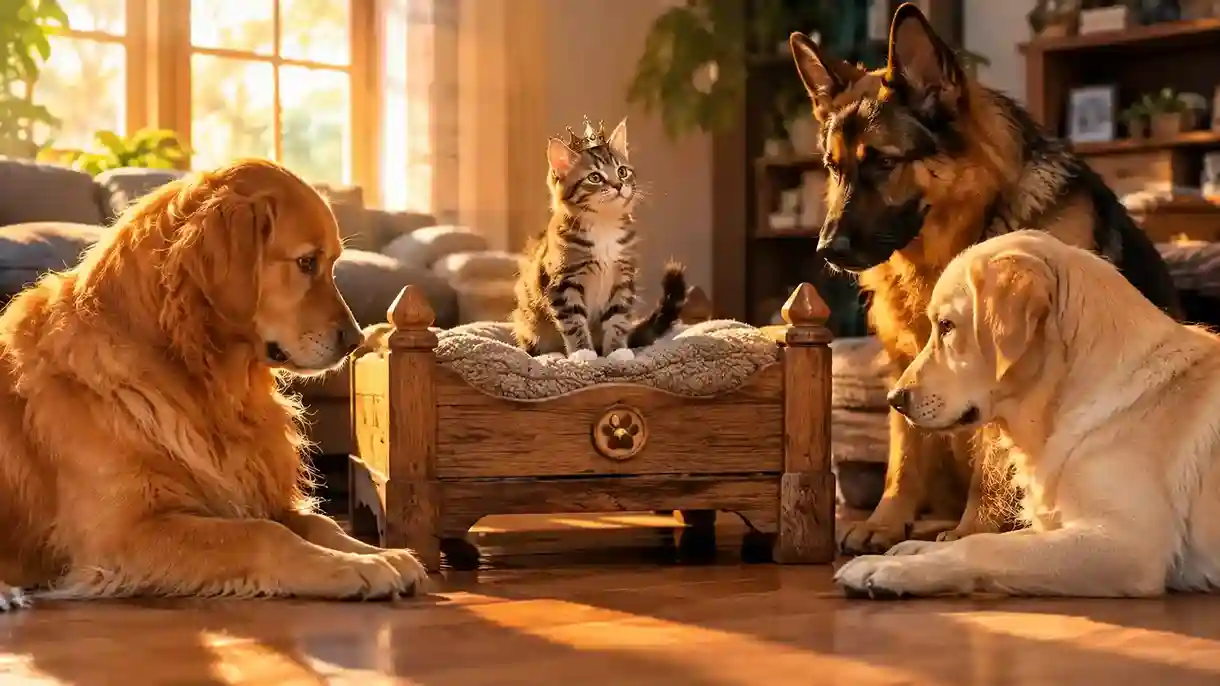
A ten-week-old kitten walks into a room full of dogs. Within a minute, three grown Labradors back away from the food bowl. This is exactly how a baby cat who commands the dog clan takes over a household without anyone noticing until it’s already done.
This guide breaks down why a baby cat who commands the dog clan is more common than most pet owners realize. Once you understand why it works, you’ll never look at your pets the same way again.
Why a Baby Cat Who Commands the Dog Clan Ends Up Running the Show
Dominance inside a multi-pet household hierarchy isn’t about size, breed, or even species. It’s about confidence, timing, and who blinks first during the first few interactions.
The Confidence Factor
Kittens that grow up without fear of dogs — often because they were raised alongside them from birth — treat every dog as an equal rather than a threat. This fearless posture is exactly what turns an ordinary kitten into the baby cat who commands the dog clan in just a few weeks.
Size Doesn’t Matter in the Animal Kingdom
Household hierarchies are built on behavior patterns, not body mass. Many households where a kitten dominates the dog pack report the smallest animal acting like the boss of the group.
It’s a pattern trainers and behaviorists see constantly, even if it still surprises new pet owners every time a baby cat who commands the dog clan first shows its confidence.
Signs Your Baby Cat Who Commands the Dog Clan Has Already Taken Charge
Some households don’t even realize the shift has happened until they look for the clues. Watch for these patterns of cat pack leader dynamics:
- The dogs wait for the cat to eat first, even when the dog’s bowl is closer
- Dogs step around the cat’s favorite spot instead of walking through it
- A single meow or paw-raise stops rough play instantly
- Dogs check the cat’s reaction before approaching a new toy or guest
- The cat sleeps in the “best” spot without protest
- Larger dogs visibly soften their body language around the kitten specifically
If three or more of these sound familiar, congratulations — your baby cat who commands the dog clan has officially taken over.
The Science Behind Cross-Species Hierarchies
Dogs read body language obsessively. Cats communicate almost entirely through body language. That overlap is exactly why a baby cat who commands the dog clan forms so easily, even between species that supposedly don’t get along.
| Behavior Signal | What the Cat Does | What the Dog Reads It As |
| Direct stare | Unbroken eye contact | Confidence, possible challenge |
| Slow blink | Relaxed eye closing | Trust, non-threat |
| Arched back / puffed tail | Sudden size increase | Warning, back off |
| Standing ground | Refuses to move | Territorial ownership |
| Swat or hiss | Quick, sharp correction | Clear boundary, respected instantly |
| Rubbing against dog | Scent marking | Social bonding, acceptance |
That’s the blueprint every baby cat who commands the dog clan follows without ever being taught it. Cats correct behavior instantly and consistently, while dogs are pack animals that crave clear leadership — the real engine behind kitten alpha behavior in mixed-species homes.
How to Keep the Peace When a Baby Cat Who Commands the Dog Clan Rules the House
This dynamic is usually harmless and even healthy, but a baby cat who commands the dog clan still needs a human referee watching from the sidelines.
Setting Boundaries Without Breaking the Bond
Let the natural hierarchy exist, but don’t let it turn into bullying in either direction. A cat swatting to set a boundary is normal. A cat repeatedly cornering a nervous dog is not — even when it’s the baby cat who commands the dog clan doing the cornering.
Give every animal their own food station, resting spot, and escape route. Strong cat and dog bonding depends on every pet feeling safe, not just the one in charge.
When to Step In as the Owner
Step in if a dog becomes anxious, withdrawn, or reluctant to enter shared spaces. Step in if the cat starts guarding resources aggressively rather than just enforcing polite manners.
- Separate feeding stations to avoid resource guarding
- Supervise the first several weeks of any new pairing closely
- Reward calm coexistence with treats and praise for both animals
- Never punish the dog for backing down — it’s a normal social response
- Give the cat vertical space (shelves, cat trees) so it can exit tension on its own terms
Real-Life Signs This Dynamic Is Healthy, Not Harmful
A baby cat who commands the dog clan should create calm coexistence, not constant conflict. Healthy signs include dogs and cats sleeping near each other, playing without escalating into real aggression, and both species approaching each other voluntarily.
Unhealthy signs look different: a dog that hides constantly, refuses to eat, or shows prolonged stress signals like excessive panting needs intervention, not admiration for the cute hierarchy.
FAQs
Why do dogs let a kitten boss them around?
Dogs respond to confident, consistent body language more than size or species. A baby cat who commands the dog clan earns the same respect a pack leader would.
Is it normal for a cat to dominate a much bigger dog?
Yes, this is a well-documented pattern. A multi-pet household hierarchy is built on personality and consistency, not physical size.
Can this dynamic hurt the dog emotionally?
It can, if the cat’s behavior crosses into constant aggression rather than occasional boundary-setting. Watch for stress signs like hiding, appetite loss, or avoidance.
Should I train my dog to stand up to the cat?
No. Forcing a dog to challenge an established hierarchy usually creates conflict rather than balance.
Does this happen more with certain dog breeds?
Gentle, people-pleasing breeds tend to defer more easily, while independent or guarding breeds may take longer to accept a baby cat who commands the dog clan — but it can happen with almost any breed.
At what age do kittens start asserting dominance?
Many kittens begin testing boundaries as early as eight to twelve weeks old, right around when their confidence and coordination develop quickly.
How long does it take for the hierarchy to settle?
Most multi-pet households see a baby cat who commands the dog clan situation stabilize within a few weeks to a couple of months, depending on supervised interaction early on.
Final Verdict
A baby cat who commands the dog clan isn’t a fluke — it’s biology, confidence, and timing lining up perfectly. The households that handle a baby cat who commands the dog clan best aren’t the ones trying to stop it — they’re the ones watching closely and letting their pets sort out a surprisingly fair system on their own terms.