What Are BrandRank.ai Normalization Transformation Rules?
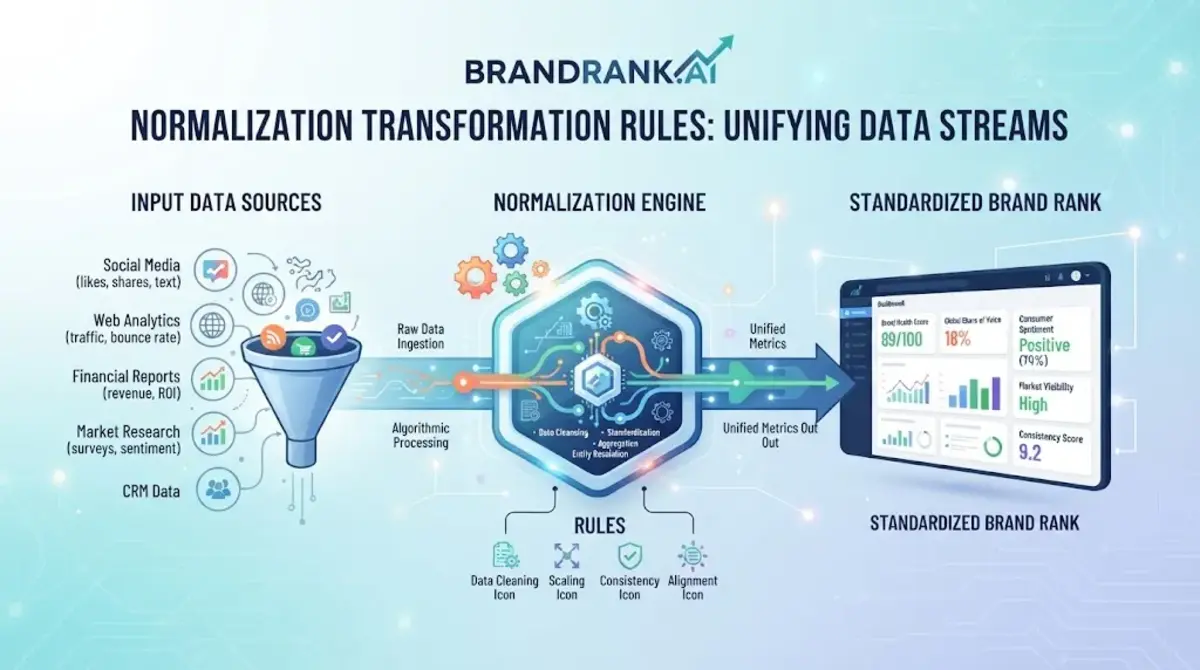
Search the phrase BrandRank.ai normalization transformation rules and you will find a dozen articles that sound certain. Most cite nothing. Your spending is wasted and your brand strategy is misguided as a result of this misconception. This guide separates what BrandRank.AI actually publishes from the data practice behind the phrase, then hands you a working plan.
What Do BrandRank.ai Normalization Transformation Rules Actually Mean?
The phrase combines two real ideas: normalization and transformation. Normalization makes equivalent values match. Transformation reshapes raw data into a standard format that other systems can use.
In practice, BrandRank.ai normalization transformation rules is shorthand for how a brand’s names, domains, products, and mentions get cleaned up so AI systems read them as one entity. The phrase works as a label for a method. It does not name a published specification.
Here is the quick answer for busy readers:
- Normalization turns “BrandRank AI,” “Brand Rank,” and “brandrank.ai” into one canonical entity.
- Transformation turns messy AI answers into structured fields such as mentions, citations, topics, sentiment, and competitors.
- Together, they let you compare brand performance across AI answer engines without noise.
Who Is BrandRank.AI and What Does It Measure?
BrandRank.AI is a Cincinnati-based analytics platform that tracks how brands appear inside AI answer engines. Its public launch announcement in May 2025 described three core metrics: AI search visibility, AI vulnerability, and content readiness (EIN Presswire, May 1, 2025).
In spring 2026, BrandRank.AI and the research consultancy Burke, Inc. announced a partnership. The first joint tool, BRAND ANSWER, shows how AI answers portray a brand, where the brand is missing from key consumer questions, and how it compares with competitors (PR Newswire, May 7, 2026).
Those are the named frameworks and tools you can verify today:
- The Brand Health and Trust framework
- The three-score model: visibility, vulnerability, readiness
- The BRAND ANSWER diagnostic
Are BrandRank.ai Normalization Transformation Rules an Official Framework?
No public evidence says so. We reviewed BrandRank.AI’s launch announcement, the Burke partnership release, and the company’s public descriptions. We found no BrandRank.AI page that defines BrandRank.ai normalization transformation rules as a product module, a schema, or a scoring formula.
Several websites describe a proprietary “normalization score” or a “7-step method.” None of them link to a BrandRank.AI document that backs the claim. Treat those pages as commentary, not documentation.
This matters for your own content. If you publish a claim that a vendor owns a rule set, and the vendor never wrote it, you lose reader trust and weaken your E-E-A-T signals. Say what is verified, then explain the method as your own framework.
| Claim you may see | What the public record shows |
| BrandRank.AI has a formal normalization rulebook | No such document appears in its public materials |
| A secret 7-step normalization method exists | No source ties it to BrandRank.AI |
| BrandRank.AI measures AI visibility, vulnerability, readiness | Confirmed in its launch announcement |
| BRAND ANSWER diagnoses AI brand portrayal | Confirmed in the Burke partnership release |
What Is the Difference Between Normalization and Transformation?
People swap these words, but the jobs differ. One cleans identity. The other reshapes data.
| Feature | Normalization | Transformation |
| Main goal | Make equal values consistent | Convert raw data into a standard model |
| Example input | “BrandRank AI,” “Brand Rank,” “brandrank.ai” | A full AI answer paragraph |
| Example output | One canonical entity: BrandRank.AI | Fields: mention, citation, sentiment, competitor |
| Main risk | Merging two brands that are actually different | Losing context when you flatten text |
| Who owns it | Brand and SEO team | Analytics and data team |
A useful habit: keep the original text next to the cleaned value. You can always audit what the AI actually said.
Why Is Brand Entity Normalization Necessary for AI Answer Engines?
AI response engines do not read pages in the same way that humans do. They match patterns across many sources and decide which names refer to the same thing. When your brand appears as five different strings, the model may split your authority into five weak signals.
This is the fundamental idea behind both answer engine optimization (AEO) and generative engine optimization (GEO). A clean, consistent entity gives AI systems one clear thing to cite.
Entity resolution is the technical term for the matching stage. It is not spell-checking. It decides whether “Apple the fruit” and “Apple the company” are one entity or two. Your job is to remove every reason for the model to guess about your brand.
Which Normalization Rules Should Your Brand Apply?
Start with identity. These six rules cover most of the damage:
- Pick one canonical name. Write it the same way in every title, bio, and profile.
- Fix capitalization and punctuation. Choose “BrandRank.AI” or “BrandRank.ai” once and keep it.
- Align the domain. Redirect www, http, and alternate domains to one version.
- Standardize legal suffixes. Use “Inc.” or “LLC” only where the law requires it. Elsewhere, drop it.
- Name products consistently. Give each product one official name and one short alias list.
- Match your location and category. Everywhere you go, use the same industry label and address format.
Two examples show the effect:
| Before | After |
| Brand Rank AI, BrandRank, brandrank.ai | BrandRank.AI |
| Acme Widgets Inc., ACME WIDGETS, Acme | Acme Widgets |
For every brand, maintain a brief list of aliases. The list tells your team which variants to fix and which to leave alone.
Which Transformation Rules Turn AI Answers Into Usable Data?
Once you collect AI answers, you need a repeatable way to score them. Transformation rules give every answer the same shape.
- Extract mentions. Record every time your brand name or alias appears.
- Extract citations. Record which URLs the engine names as sources.
- Tag sentiment. Label each mention positive, neutral, or negative.
- Tag topics. Link each mention to the question theme, such as pricing or safety.
- Tag competitors. Record every rival named in the same answer.
- Rescale metrics. Convert counts and scores to a shared 0–100 range so no single metric dominates.
Rescaling deserves a warning. Min-max scaling is sensitive to outliers. Log scaling or percentile ranks handle wide gaps better. Pick one method and document it.
How Do You Build a Brand Entity Record?
A brand entity record is a single reference sheet your whole team uses. Build it before you touch any profile or page.
- List your canonical brand name, legal name, and approved short name.
- List your primary domain and every redirect.
- List each product, service, and the one approved name for it.
- List founders and executives with their exact titles.
- List your official profiles: LinkedIn, Crunchbase, Wikipedia, Wikidata, and industry directories.
- Add a version date and an owner.
Then mirror this record in your site markup. Google documents Organization structured data, including name, URL, logo, and sameAs links that point to your official profiles (Google Search Central). The sameAs property tells machines that your website and your profiles describe the same entity.
How Do You Fix Name Variations Across the Web?
Work from the highest-authority sources down. Edit what you control first. Request changes where you do not.
- Your own site: titles, headers, footers, About page, schema markup.
- Owned profiles: social accounts, app stores, review sites you can claim.
- Partner and press pages: send partners your approved name and logo file.
- Public databases: update Wikidata and directory listings with sourced facts.
Do not mass-edit old press releases. Add a short correction request instead. Keep a log of every change and its date.
How Do You Measure Whether the Rules Work?
Track the effect of your BrandRank.ai normalization transformation rules with a baseline and a retest. Run the same set of buyer questions across the major AI answer engines before and after your cleanup.
Watch these signals:
- Share of answers that mention your brand
- Share of mentions that use your canonical name
- Number of correct citations pointing to your domain
- Share of answers that name a competitor instead of you
- Sentiment shift on key topics
Retest every month. AI answers change often, so one snapshot proves little. Add your own result here: [insert a before-and-after example from your brand, with dates and numbers]. First-hand data is the strongest trust signal on this page.
What Mistakes Break Normalization?
Most failures come from speed, not from bad intent.
- Over-merging. Two brands share a name, and you collapse them into one.
- Silent rule changes. You edit a rule and lose your history. Version every rule set.
- Deleting the original text. Keep the raw string for audits.
- One-time cleanup. Rebrands, redirects, and renamed products break a clean record within months.
- Claiming a vendor’s authority. Never describe a method as a vendor’s official rule set without a source.
Where Does This Topic Go Next?
This page serves as the pillar for BrandRank.ai normalization transformation rules and the wider topic map around it. Each cluster below deserves its own supporting article that links back here.
| Cluster topic | Supporting article idea |
| Entity resolution | How AI models decide two names mean one brand |
| Structured data | Organization schema and sameAs, step by step |
| AEO measurement | How to build a repeatable AI visibility audit |
| Brand health in AI | What the Brand Health and Trust framework scores |
| Data scaling | Min-max, log, and percentile scaling for brand metrics |
| Knowledge graph | Wikidata and directory clean-up for brands |
Your Next Step: Start Applying BrandRank.ai Normalization Transformation Rules Today
You now know what is verified and what is folklore. BrandRank.AI measures visibility, vulnerability, and readiness. The normalization and transformation practices are a sound data discipline you can apply yourself.